A value-led golden quarter as inflation weighs on confidence
KEY TAKEAWAYS
Consumer
- Consumer pressure is rising: Higher inflation and weaker confidence are reinforcing more selective spending.
- Retail parks are better insulated: The shift towards grocery, discount and essential retail has strengthened resilience.
- Policy support only goes so far: Budget measures offer some relief, but higher rates will continue to weigh on big-ticket spending.
- Christmas should hold up: Festive spending remains resilient, but value, promotions and Black Friday will be increasingly important.
- Out-of-town remains well positioned: Value, convenience and purposeful shopping continue to favour the retail park format.
Consumer backdrop
The consumer backdrop has become more challenging as the golden quarter begins. CPI inflation increased from 3.1% in August to 3.5% in September, driven principally by higher energy and fuel costs. Retail sales volumes subsequently fell by 0.4% in September, although they remained 0.8% above the same month last year and increased by 0.7% across Q3 as a whole. This points to a loss of momentum rather than a collapse in spending, but households are once again having to absorb higher essential costs before deciding how much they can allocate to discretionary purchases.
The effect on sentiment has been more pronounced. The NIQ/GfK Consumer Confidence Index fell 11 points to -24 in October, reversing the improvement seen over the summer. The deterioration appears to reflect not only renewed cost pressures, but growing uncertainty ahead of the Budget, which encouraged households to take a more cautious view of both the economy and their own spending. Expectations for the wider economy and the Major Purchase Index recorded the largest declines, both falling by 14 points. Personal finance expectations also weakened, suggesting consumers are becoming more cautious about committing to large purchases even where their current finances remain manageable.
This distinction is particularly relevant to retail warehousing. As highlighted in our previous Spotlight, the sector’s occupier mix has shifted materially towards value and essential retail: bulky goods, homewares and electricals fell from 46.8% of floorspace in 2012 to 31.0% in 2025, while discount grocery increased from 1.3% to 5.6%, helping to lift convenience overall from 11.5% to 16.6%. Discount variety saw an even more significant increase, rising from 4.2% to 15.9%. This structural shift leaves the sector better aligned with more resilient areas of consumer spending, although furniture, electricals, kitchens and larger home improvement projects remain more exposed to consumer caution. Higher fuel costs are an additional sensitivity for a predominantly car-accessed format, although retail parks’ accessibility, free parking and ability to combine several shopping missions in one trip should continue to support their relative performance.
Indeed, MRI data shows retail parks were the only retail subsector to record year-on-year growth in average weekly footfall in every quarter, with Q3 footfall increasing by 1.8%. Their continued outperformance reflects the convenience of the format and its greater exposure to value, essential goods and purpose-driven shopping. As household budgets tighten, consumers are likely to make fewer speculative trips but remain willing to travel where they can compare prices, complete several purchases and access convenient parking in one location.
The Budget offers support, but not a consumer reset
The Autumn Budget provides some targeted assistance to households and smaller businesses, but it is unlikely to transform the near-term spending outlook. Measures include a £100 Household Energy Payment for eligible households in Council Tax bands A–D in England from January 2027, alongside an extension of zero VAT on household electricity. These measures should provide some relief from higher living costs, particularly for lower-income households, but are unlikely to fully offset the renewed pressure from energy and wider inflation.
That pressure has subsequently been reinforced by monetary policy. The Bank of England raised Bank Rate by 25 basis points to 4.0% in November as higher energy costs intensified inflationary pressures, with CPI now expected to reach around 5% by mid-2027. For consumers, the increase adds further pressure to borrowing costs and could delay the recovery in big-ticket spending, particularly among mortgage holders refinancing onto higher rates. For retail warehousing, this is most relevant to more deferrable furniture, electrical and larger home improvement expenditure, rather than the sector’s increasingly important grocery and value-led offer.
For retailers, the Budget presents a similar trade-off. The increase in the National Living Wage from April 2027 may support disposable incomes among lower-paid households but will also add directly to payroll costs across a labour-intensive sector. The benefit from stronger household spending is therefore less certain than the increase in employment costs, reinforcing operators’ focus on productivity, store efficiency and more selective expansion.
Changes to business rates are helpful, but their impact on retail warehouse operators should not be overstated. From April 2027, the threshold for full Small Business Rates Relief for qualifying retail, hospitality and leisure properties in England will rise from a rateable value of £12,000 to £18,000, with tapered relief extending to £21,000. The Government estimates that a further 70,000 businesses will consequently pay no business rates, while bills for the remaining eligible retail, hospitality and leisure sector will be frozen in real terms for two years.
This will provide meaningful support to smaller independent occupiers and some leisure, service and food and beverage operators. However, most mainstream retail warehouse units occupied by national retailers have rateable values well above the revised thresholds, limiting the direct benefit to larger DIY, grocery, homeware, furniture and electrical operators. For these businesses, the wider rates measures provide greater cost certainty rather than a material reduction in occupational costs. Consequently, the changes are likely to be more meaningful for smaller occupiers than for the anchors that account for much of retail warehouse floorspace.
Christmas spending historically proves resilient
Long-run evidence provides some reassurance for the golden quarter. Since 1996, December retail sales excluding fuel have increased by an average of 2.0% a year in volume terms and 3.4% in value terms, with volumes falling year-on-year in only five of the past 30 years. Historically, inflation has been the clearest constraint: when CPI has been between 2% and 4%, December volumes have increased by an average of around 1.2%, compared with a 2.6% decline when inflation has exceeded 4%. Against the current backdrop, this points towards Christmas spending being protected, but with volumes more subdued than the long-term average.
Consumers are becoming more selective, but retail warehousing is increasingly aligned with where they choose to spend
Sam Arrowsmith, Director, Commercial Research
Consumers' stated intentions support that view. The Institute of Practitioners in Advertising (IPA) 2026 Christmas Consumer Report found that 49% do not intend to cut back on any aspect of Christmas, up from 42% last year, while average expected festive spending has increased to £647, £84 higher than two years prior. However, 45% expect to feel more financially anxious because of rising costs, suggesting consumers will seek to preserve Christmas by shopping more selectively and making greater use of promotions.
Black Friday will consequently be particularly important. Some 22% expect to spend up to half of their Christmas budget during Black Friday, up from 16% last year, while Mintel found that more than 70% of Black Friday shoppers bought Christmas gifts during the event in 2025. With 34% of consumers now buying Christmas gifts in November and a further 26% in December, the peak is becoming increasingly compressed and promotion-led.
For retail warehousing, this should favour the sector’s growing exposure to grocery, discount and value-led retail, where spending is more needs-driven and price-conscious consumers are more likely to seek value. Black Friday will be particularly important for electricals and selected home categories, although retailers will need to capture promotion-sensitive demand without unnecessarily sacrificing margin or simply pulling December spend forward into November.
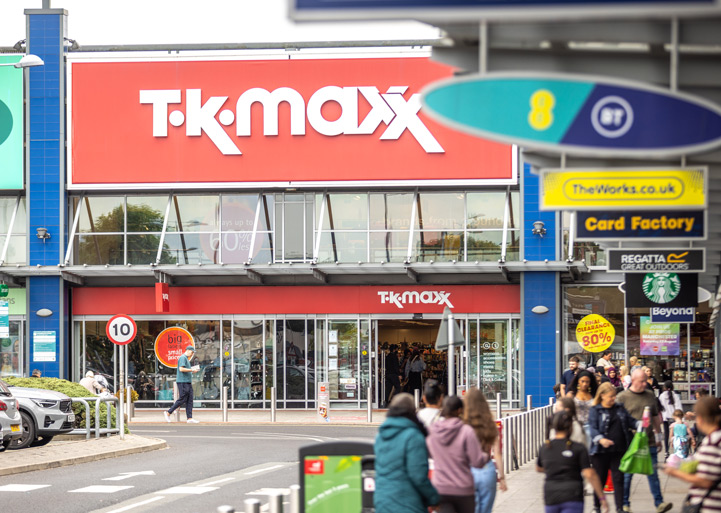
THE FORT, MANCHESTER
OUTLOOK: Selective spending favours retail warehousing
The most likely outcome is a steady rather than exceptional golden quarter. Value growth should continue to run ahead of volumes, with consumers protecting food and essential spending while remaining cautious around larger discretionary purchases. Retail parks should retain their relative advantage because their offer closely matches the priorities of the current consumer: value, convenience, accessibility and the ability to complete several purposeful shopping missions in one trip.
Beyond Christmas, the outlook will depend heavily on inflation and interest rates. If energy and fuel pressures ease, improving real incomes should gradually release demand for postponed home improvement, furniture and electrical purchases. If inflation remains elevated and borrowing costs rise, the recovery in big-ticket spending will be delayed. Either way, the sector’s value-led tenant base and needs-driven offer leave it better positioned than most retail formats to navigate a period of selective consumption.
Read the articles within Spotlight: UK Retail Warehousing below.